
Last updated November 15, 2026
 Wrought iron
 Wood & steel frame
 Farm & ranch
 Sliding driveway gates
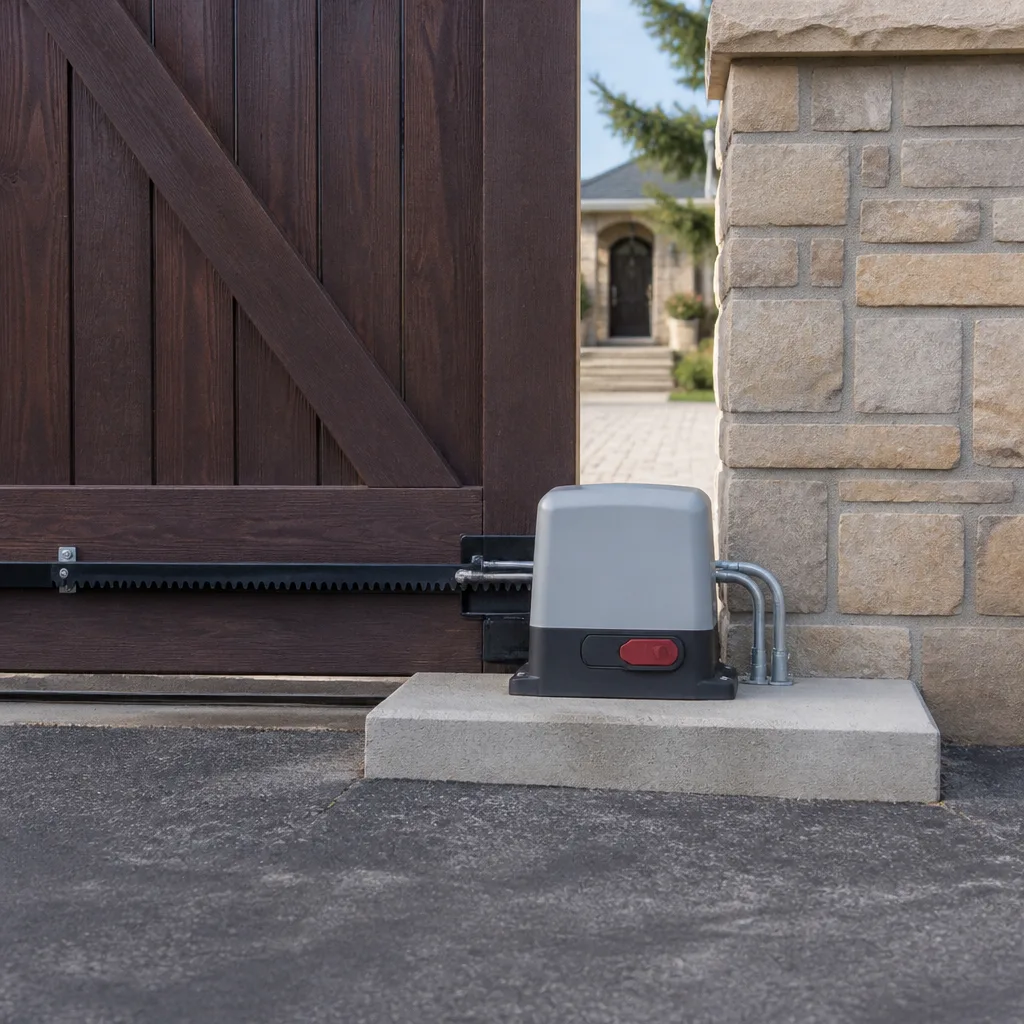 LiftMaster operators
Free on-site gate assessment - hinges, posts, and your LiftMaster or Nice gate operator checked before anything is quoted
The assessment is free and the quote is the invoice.
Get your free estimateGate Repair Maintenance Checklist for Enterprise Homeowners
Most gate maintenance advice was written for a temperate suburb with soft rain and mild summers. Applied to Enterprise, it fails. The Las Vegas Valley’s water is mineral-heavy, the summer sun pushes past 110°F for weeks, and alkaline dust settles into every moving part an operator has. Calcium scale can start building inside gate operator housings well within 18 months here, a failure path that hardly exists in wetter, cooler markets and that a generic annual “check for wear” never catches. This guide gives you a task-by-task inspection sequence calibrated to Enterprise conditions: specific pass/fail criteria, a scale-removal protocol, UV benchmarks, lubrication specs by component, and a log you can hand to a specialist.
Quick Answer
A gate maintenance checklist for Enterprise, NV should run monthly, quarterly, and annually, with each interval targeting the local stressors: dust infiltration, UV damage, hard-water scale, and heat-driven lubricant breakdown. Inspect and log hinges, rollers, tracks, operator housing, photo-eyes, wiring insulation, and safety edges against measurable pass/fail criteria, and lubricate each component with the correct product for desert heat. Anything involving the operator’s power supply, control board, or high-voltage wiring belongs with a trained gate technician, not a homeowner.
Styles & brands we work with
- Wrought iron
- Wood & steel frame
- Farm & ranch
- Sliding driveway gates
- LiftMaster operators
Table of Contents
- Why a Standard Gate Checklist Falls Short in Enterprise
- The Monthly Walk-Around: What to Check and Pass/Fail Marks
- Hard-Water Scale: The Protocol for Housings, Hinges, and Conduits
- UV Degradation Benchmarks for Seals, Lenses, and Wiring
- Lubrication by Component: Why the Wrong Product Fails Faster Than None
- The Quarterly and Annual Deep Checks
- Building a Maintenance Log a Specialist Can Read
- Safety Edges, Photo-Eyes, and What Not to Touch
Why a Standard Gate Checklist Falls Short in Enterprise
Enterprise sits in a specific pocket of the Mojave: hot, dry, dusty, and supplied by water that carries a heavy mineral load. Each of those conditions attacks a different part of your gate system, and they compound. Dust that settles into a roller bearing holds grit against the metal. Heat thins the lubricant meant to flush that grit out. Hard water etches scale onto any surface that sees irrigation overspray or condensation. UV light degrades the rubber and plastic that seal all of it.
A maintenance schedule copied from a national gate company’s website assumes none of this. It tells you to “inspect for wear and lubricate as needed” and leaves you with no threshold for “worn” and no idea which lubricant “as needed” means in 112°F heat. The result is a gate that passes an annual visual check right up until the operator quits, and then the homeowner learns the control board has been cooking behind a housing full of dust and scale.
Homeowners in Enterprise who want their gate to last need a checklist with numbers, materials, and an order of operations. That is what follows. We’re Gate Repair Enterprise, a gate-only specialist, and this is the sequence our technicians use on the systems we see most: LiftMaster, FAAC, BFT, and Mighty Mule among them, plus the manual and sliding gates common in newer Enterprise neighborhoods.
The checklist assumes a residential swing or slide gate with an automated operator, though the manual-gate sections apply to any gate. Work through it in order. Each section stands alone, so you can start with whatever interval fits your schedule.
The Monthly Walk-Around: What to Check and Pass/Fail Marks
The monthly walk-around takes about 15 minutes and catches most developing problems before they cost you an operator. Do it in daylight with the gate powered but not in motion. Bring a rag, a flashlight, and your log.
Work through these steps in order:
- Walk the full swing or slide path. Look for fresh scrape marks on pavement or posts. Pass: clean path. Fail: any new metal-on-metal contact, which means a hinge or roller has dropped.
- Test gate movement by hand with the operator disengaged. On most operators there’s a manual release lever. A properly adjusted gate should swing or slide with light one-hand pressure. Fail: any point where you need two hands or the gate binds, which signals a hinge, roller, or track problem.
- Check gate sag at the latch end. With the gate closed, look at the gap between the latch and the post. Pass: consistent gap top to bottom. Fail: a gap that widens at the top, which means hinge wear.
- Inspect the hinges and rollers visually. Pass: metal surfaces show a light film of lubricant and no rust blooms. Fail: any orange oxidation, dried-out grease, or grit packed into the pin.
- Check the operator housing seams. Pass: gasket or seal sits flush and no dust plume marks. Fail: visible gaps, warped seals, or a line of fine dust where the housing meets the ground.
- Look for scale deposits. Pass: no white or chalky buildup. Fail: any crust on hinges, the operator mount, or the underground conduit cap.
- Confirm the photo-eye status light. Pass: steady, clear. Fail: flickering, off, or amber when it should be green.
- Test the safety reverse. With the gate moving, block the path with an object (never your body). Pass: gate reverses immediately. Fail: gate continues through the object.
Write the date and your readings in the log. Anything in the “fail” column gets addressed at the quarter or escalated immediately if it involves an electric gate problem. For homeowners in the newer communities on the east side of Enterprise, where gate systems are often FAAC or BFT, the monthly checks are identical but the housing seals are tighter and worth watching carefully for dust ingress.
Hard-Water Scale: The Protocol for Housings, Hinges, and Conduits
Hard water is the maintenance issue Enterprise homeowners underrate. When irrigation overspray, condensation, or the occasional splash of tap water dries on metal, it leaves calcium and magnesium behind. Repeated wet-dry cycles build those minerals into a crust. Inside an operator housing that crust traps grit against bearings. On hinges it abrades the pin. In the underground conduit that carries loop-detector wiring, scale can narrow the conduit enough that moisture wicks rather than drains, and eventually corrodes the wire.
Here is the scale-removal protocol we recommend, in order, done quarterly:
- Isolate the operator. Shut off power at the breaker before opening any operator housing. Do not skip this. The inside of an operator carries line voltage and stored energy in capacitors.
- Dry-brush first. Use a stiff nylon brush (never metal on a painted housing) to lift loose scale and dust. Work away from the seam so debris falls out, not in.
- Apply a mineral-specific cleaner to accessible surfaces. A dilute white vinegar solution on the exterior of the housing, hinge pins, and galvanized mounts loosens calcium. Wipe it off within a few minutes. Vinegar left to dry becomes its own residue.
- Dry completely with compressed air or a microfiber cloth. Pass: surface is dry and residue-free before you close anything back up. Fail: any tacky feel, which means cleaner is trapped.
- Re-lubricate immediately. Scale removal strips whatever protection was there. Apply the correct lubricant to hinges (see the lubrication section) within the same visit.
- Flush and rod the conduit cap area. Do not open conduit connected to live loop-detector wiring. Instead, clear debris from the top cap and check that the drain path is open. If the conduit runs visibly wet on dry days, that signals a loop fault you should hand to a specialist.
For the scale around the operator’s exterior housing on a LiftMaster or Mighty Mule system, check the manufacturer’s cleaning guidance first: some alloys don’t take acidic cleaners. When in doubt, use water and a nylon brush, then dry.
Community gates in Enterprise see this problem worse because the surrounding landscaping runs on irrigation and the overspray hits the equipment. Property managers should schedule the scale quarterly check for the whole season from May through September, when evaporative drying concentrates the minerals fastest.
UV Degradation Benchmarks for Seals, Lenses, and Wiring
Mojave sunlight above 110°F does two things to a gate system that cooler climates don’t: it degrades polymer components faster, and it accelerates the surface cracks that let dust and moisture in. Here are the benchmarks worth tracking, with pass/fail called out plainly.
- Rubber and EPDM seals on operator housings: Pass = flexible, no visible cracks, compresses under thumb pressure and returns. Fail = hardened, chalky surface, hairline cracks at the corners, or “memory” that doesn’t spring back.
- Photo-eye lenses: Pass = clear, no yellowing, light output visible from 10 feet in daylight. Fail = hazed, clouded, or noticeably dimmer than the second unit on the same installation. When one lens hazes earlier than its partner, that unit is taking more sun exposure.
- Wiring insulation: Pass = continuous jacket, no cracking where the wire turns. Fail = cracking jacket, exposed conductor at stress points, or a jacket that feels brittle or like a dry noodle. Do not flex or tug wiring connected to a live operator.
- Sealant around housing penetrations: Pass = continuous and pliable. Fail = separated, cracked, or missing at the corners.
- Rubber edge pads on swing gates: Pass = soft, uniform. Fail = hardened, chipped, or cracked.
UV doesn’t just damage the plastic. It breaks down plasticizers in the compound, which is why a seal that looked fine in year two is brittle in year three. For desert exposure, plan to replace rubber seals and photo-eye lenses on a shorter cycle than a manufacturer’s national guidance suggests. If you see a photo-eye housing with cracks and can’t get a clean drive-through test, that’s a call we’d make.
Lubrication by Component: Why the Wrong Product Fails Faster Than None
Choosing the wrong lubricant for desert heat is worse than skipping lubrication. A generic grease thins and migrates at 110°F, carrying away from the pin it was meant to coat and dripping onto pavement where it picks up dust. That dust then works back into the joint as an abrasive paste. In our experience, an unlubricated clean pin outlasts a greased pin that runs dry-thin and collects grit.
Match the lubricant to the component:
- Hinge pins and gate pivot points: A dry-film PTFE lubricant or a synthetic, high-temperature moly grease. Apply a thin film, work the gate once, and wipe excess. Do not use standard lithium grease at 110°F.
- Track rollers and slide-gate tracks: Clean first, then use a dry silicone spray. Grease on a track collects dust and grit in Enterprise’s environment and jams rollers.
- Chain drives: A purpose-made chain lubricant that penetrates the rollers and then sets without flinging off. Reapply monthly during the summer.
- Lock cylinders and latch mechanisms: Graphite or a dry PTFE spray. Never oil: oil attracts the dust that eventually locks the mechanism.
- Operator gearboxes: Follow the manufacturer’s spec exactly, and do not top up a sealed gearbox. If you suspect the gearbox is low, that’s a specialist call, not a DIY top-up.
- Photo-eye brackets and safety edge mounts: No lubricant. They should be clean and dry.
In Enterprise, the summer lubrication schedule runs tighter than the cooler months. Reapply hinge lubricant monthly from May through September, and once every other month through the rest of the year. Track what you apply in your log so a specialist later knows what’s in the joint.
The Quarterly and Annual Deep Checks
Quarterly checks go deeper than the monthly walk-around; annual checks examine the electric gate system’s internals and the structural gate install. Both are more efficient when you’ve kept a monthly log, because the log tells the specialist which readings have been trending.
Quarterly checklist:
- Re-test the safety reverse with an object on the last 12 inches of travel, a spot that strains the most.
- Check the battery backup, if the operator has one. Test by cutting power at the breaker, then measure battery voltage at the terminals (12V nominal on most residential operators; consult your manual for the exact spec).
- Inspect the operator housing seal line and clean any scale (the full scale protocol above).
- Inspect photo-eye alignment by looking for the light receiving cleanly on both sides. Any drift means a bracket has moved.
- Inspect gate hardware for loose fasteners. Use a hand tool, not a power driver, on gate brackets.
- Review the operator control board for any visible dust or corrosion through a viewport, without opening the housing.
- Log every finding with photographs if a reading has changed.
The annual check covers what’s hardest to reach:
- Inspect underground conduit caps and the loop-detector wiring path for scale and moisture.
- Check the gate posts for lean, especially on slide-gate tracks that see thermal movement.
- Inspect wiring runs from the house to the operator for jacket cracking.
- Test each remote or keypad entry device against the range and response it should produce.
- Have a qualified gate technician inspect the operator control board and any wiring inside the housing.
If your system is a LiftMaster or a FAAC and the annual review flags the control board, we can diagnose it at the source as part of our electric gate repair work. We don’t produce annual service contracts; the deep check is a one-time visit priced after we see the gate.
Building a Maintenance Log a Specialist Can Read
A maintenance log is only useful if a technician can pick it up and see trends. The right template is short and specific, so you’ll actually keep it. We use a simple form for the gates we service in Enterprise, and homeowners can replicate it.
For each component, keep a row with the date, the reading, and a pass/fail mark:
- Hinges: date, lubricant applied, visual condition (light film / dry / rust).
- Rollers and track: date, cleanliness, any dragging heard or felt.
- Operator housing seal: date, seal condition (flexible / cracked / replaced).
- Photo-eye: date, lens condition (clear / hazed), status light observed.
- Safety reverse: date, result (reversed / failed).
- Battery voltage: date, reading, ambient temperature.
- Scale observation: date, surface affected, removal performed.
- Wiring insulation: date, condition (intact / cracked / replaced).
Trend matters more than the single reading. A battery that drops from 12.6V to 12.2V over six months tells a specialist the battery is aging or charging is weak. A photo-eye status light that has drifted from green to amber across two visits tells us the bracket has moved. Without a log, we only see the failure, not the slope toward it. Bring the log to your annual check, and any gate specialist, whether us or someone else, will be able to work faster and with better diagnosis.
Safety Edges, Photo-Eyes, and What Not to Touch
The safety edges and photo-eyes are the most important components on an automatic gate and the ones homeowners should test but never modify. A gate that closes on a child, a pet, or a car because a sensor failed is a different problem than a stuck gate. Test monthly and treat any failure as urgent.
Test procedure, done safely:
- Run the gate through a full close cycle.
- Break the photo-eye beam with a rigid object (not your body) mid-travel. Pass: the gate reverses or halts.
- Repeat at the last 12 inches before fully closed. Pass: same result.
- Press the safety edge if your gate has one. Pass: the gate reverses immediately.
- Disconnect the sensor (only within the manufacturer’s permitted test protocol) and confirm the gate fails safe, i.e. stops or reverses. Consult your operator manual before doing this.
What not to touch: the operator’s internal power supply, the control board, the wiring terminals inside the housing, any underground loop-detector wiring, and any gate weight you can’t move by hand. Electric gate operators carry high-tension components and stored charge that can injure seriously; a gate panel that drops or a slide gate that leaves its track can crush. Diagnosing electric gate problems at the source is work for a trained specialist. The pass/fail tests above are for homeowners; the repairs belong with a technician.
Common Mistakes to Avoid
- Using coastal-country maintenance intervals. A national gate company’s “annual inspection” schedule won’t catch year-two scale. In Enterprise, quarterly scale and UV checks are the minimum for a system that should last.
- Greasing everything. Generic lithium grease runs thin above 100°F and carries grit into every pin. Match the lubricant to the component and check the temperature rating.
- Ignoring the photo-eye haze. Hazed lenses don’t fail all at once; they get dimmer until the gate behaves unpredictably. Treat any haze as a fail.
- Power-washing around the operator housing. Water drives scale into housing seams and can wick into wiring jackets. Dry-brush and wipe.
- Skipping the safety reverse test. It’s the one test that protects people. Test monthly, not annually.
- Topping up a sealed gearbox. Overfilling can blow a seal. Follow the manufacturer spec or leave it for the specialist.
- Discarding the log. Without a record of trends, every diagnosis starts from scratch and costs more.
See the difference
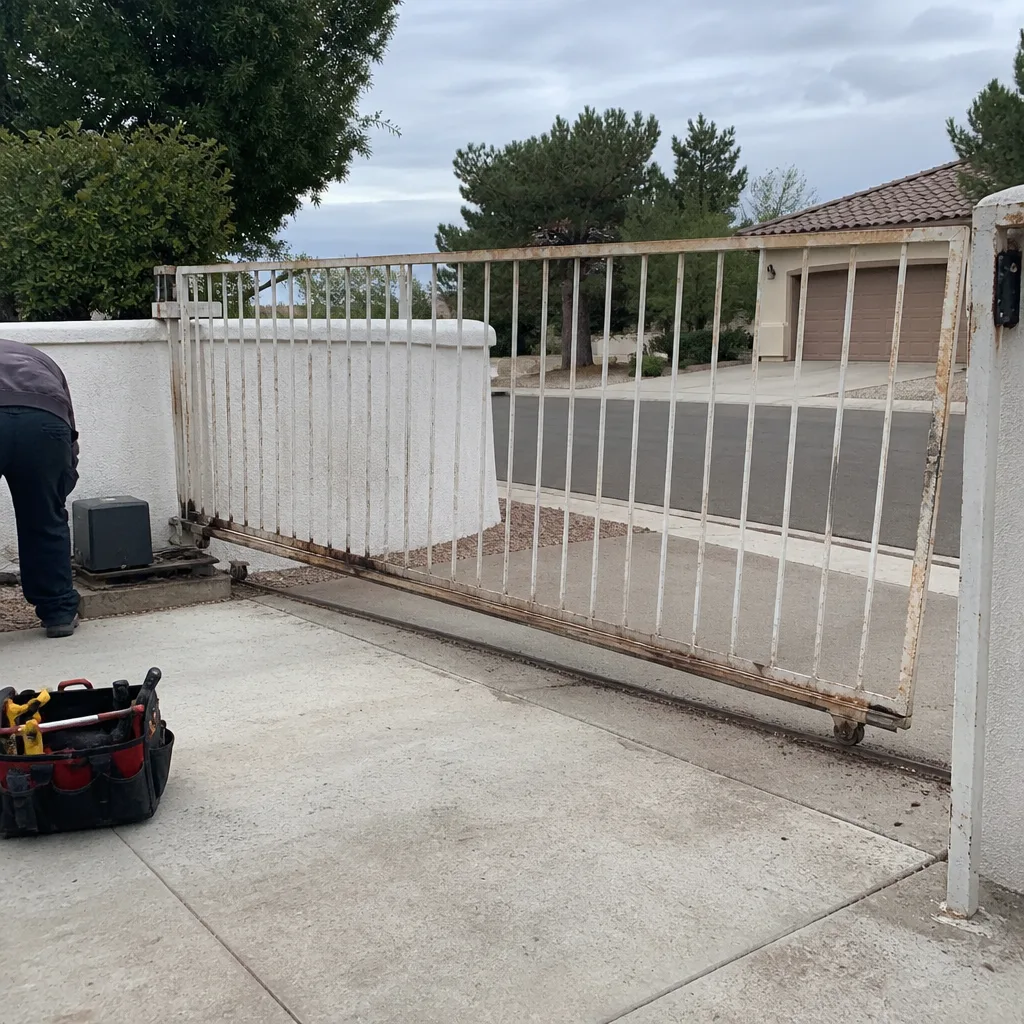 Before
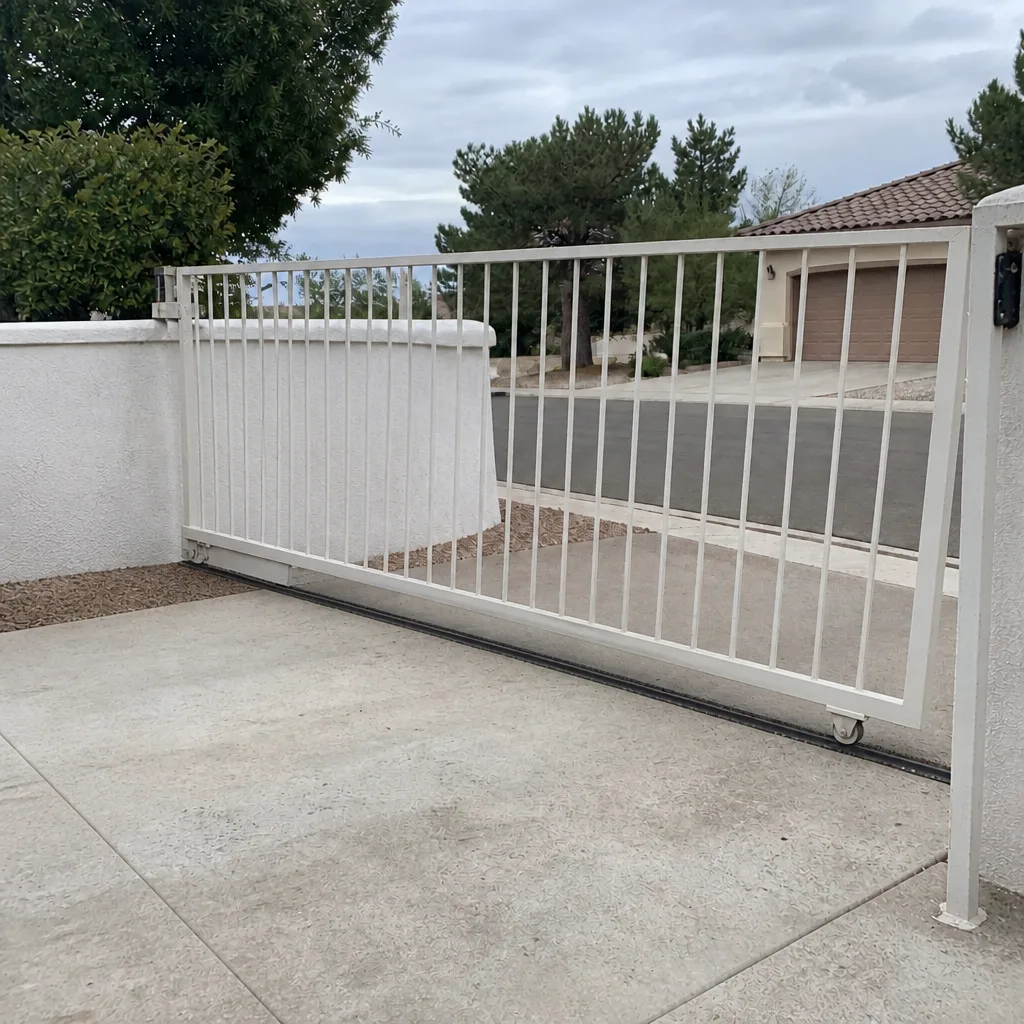 After
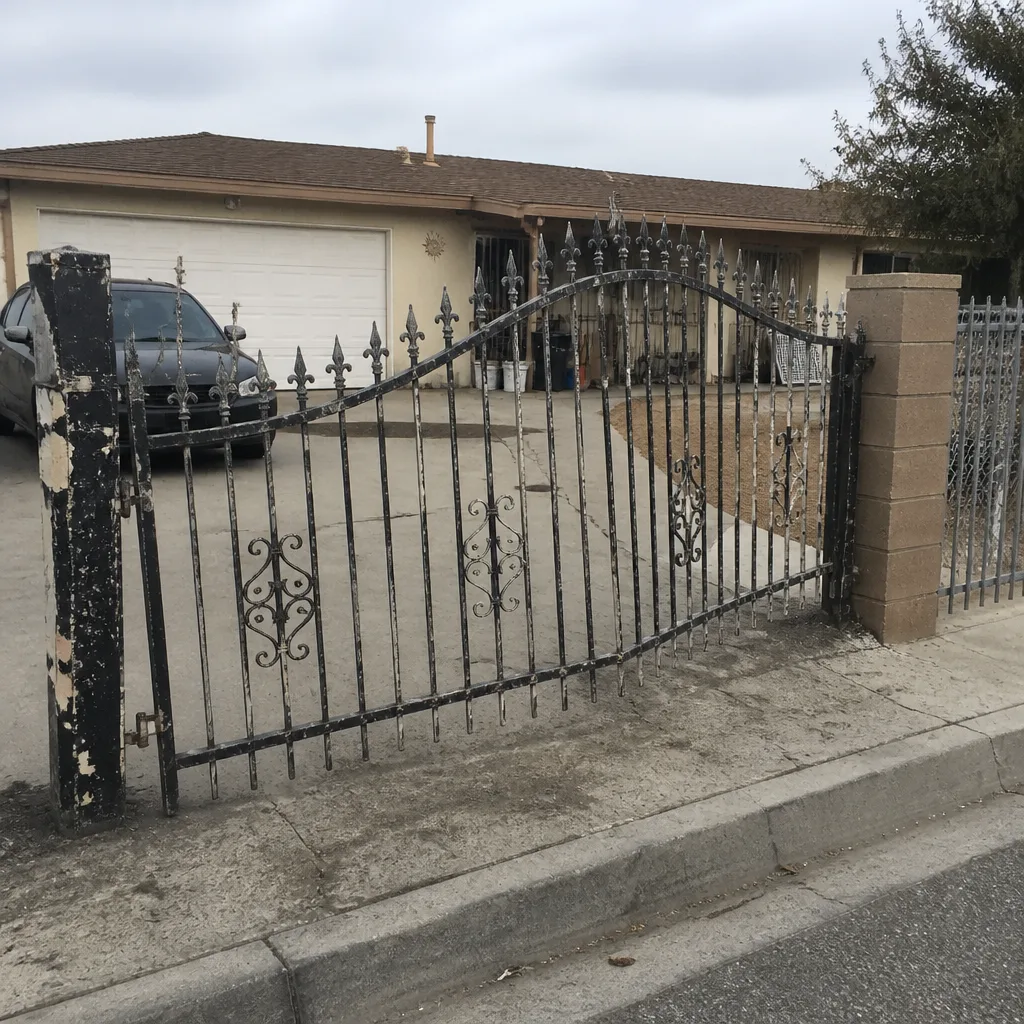 Before
 After
 Before
 After
When to Call a Professional
Call a gate specialist when any of the following is true: the operator behavior changes in a way that a reset doesn’t fix; the safety reverse fails on repeat tests; the photo-eye stays amber or off after cleaning; the gate binds or drops and manual adjustment doesn’t correct it; you find cracked wiring jacket or scale inside the conduit; the control board shows corrosion or a fault code; or the gate fails the hand-movement test even after lubrication. Systems we regularly service, including LiftMaster, FAAC, BFT, and Mighty Mule, all have model-specific quirks that benefit from a specialist’s diagnosis rather than a general contractor’s guess. Gate Repair Enterprise offers free estimates in Enterprise, and our technicians have up to 8 years of experience: call (844) 423-3067 to book a visit.
Frequently Asked Questions
Monthly for the walk-around and safety reverse test, quarterly for the deep checks and scale protocol, and annually for a specialist inspection of the operator internals and wiring. This is tighter than standard national guidance because Enterprise’s dust, heat, and hard water accelerate wear. Call (844) 423-3067 for a free estimate on a professional deep check.
Yes. Hard water leaves calcium scale that traps grit against bearings; inside a housing over time that can lead to premature failure. Dry-brush quarterly and apply a dilute vinegar solution to exterior surfaces, then re-lubricate. Never spray water into the housing. Call (844) 423-3067 if you suspect scale inside the operator.
Neither is a good choice for desert heat. Standard lithium grease thins and migrates, and a general-purpose displacement spray doesn’t provide long-term protection. Use a synthetic high-temperature grease on hinge pins, dry silicone on rollers and tracks, and dry PTFE on lock mechanisms. If you’re unsure which lubricant fits your specific operator, call (844) 423-3067.
Hazed photo-eye lenses and stiff, chalky rubber seals are the earliest signs. Wiring jacket cracking at stress points follows. If you see a photo-eye lens that has clouded relative to its partner, the sun-facing side is being degraded faster. Have it replaced rather than waiting for a failure; call (844) 423-3067.
Yes, and it’s the single easiest diagnostic you can keep. A battery that drops 0.3 to 0.5 volts over six months is a trend a specialist needs to see. Log voltage at each quarterly check, and bring the log to your annual deep check. Call (844) 423-3067 to arrange one.
Yes, monthly, with a rigid object. Safety reverse is the single most important function on an automatic gate. If it fails on repeat tests, stop using the gate and call a professional. Call (844) 423-3067 for an urgent safety edge and photo-eye inspection.
The Bottom Line
Maintaining a gate in Enterprise takes a specific checklist, not a generic one. The four stressors are alkaline dust, high UV, summer heat above 110°F, and hard-water minerals that can foul operator housings within 18 months. Monthly checks cover safety reverse, hinges, photo-eyes, and housing seals; quarterly work addresses scale and lubrication with desert-rated products; annual deep checks reach the wiring, conduit, and control board. The log matters as much as the checks, because trends catch failures before they arrive. If any reading fails, a gate specialist should see it.
Key Takeaways
- Calibrate your inspection frequency to Enterprise’s conditions: monthly, quarterly, and annually.
- Dry-brush, use dilute vinegar, then re-lubricate to remove hard-water scale.
- Match lubricant to component; the wrong grease is worse than none.
- Hazed photo-eye lenses and chalky seals are the earliest UV failure signs.
- Keep a trend log so a specialist can spot the slope toward failure.
- Test the safety reverse monthly, and call a professional if it fails.
Whether you want a free estimate on a professional deep check or a diagnosis of a specific gate problem, call us. Gate repair is what we do, we work on the brands you own, and we’ll give you a written price before any work begins. Call (844) 423-3067 for a free estimate today.
Written by the team at Gate Repair Enterprise.