
Last updated November 15, 2026
 Wrought iron
 Wood & steel frame
 Farm & ranch
 Sliding driveway gates
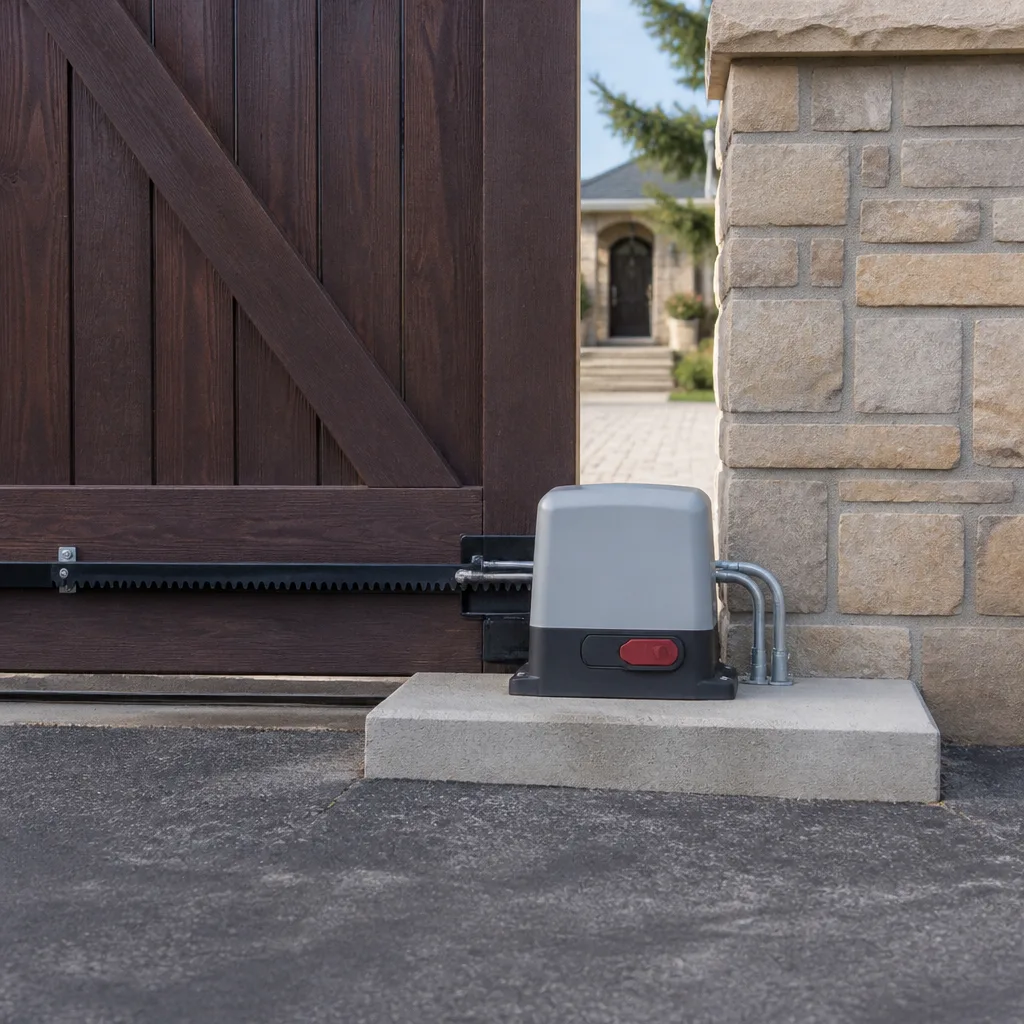 LiftMaster operators
Free on-site gate assessment - hinges, posts, and your LiftMaster or Nice gate operator checked before anything is quoted
The assessment is free and the quote is the invoice.
Get your free estimateGate Repair Maintenance Schedule: What to Do and When
Lubricating a gate hinge that has already developed a stress crack doesn’t maintain it – it hides the damage until the hinge snaps under load. Most gate failures we’re called to in Enterprise don’t start with a dramatic breakdown. They start months earlier, with a hinge that was greased instead of inspected, a limit switch that was never tested, or a battery that got checked only for “does it turn on” instead of “how much reserve does it actually hold.” A gate doesn’t need one big annual tune-up. It needs the right check at the right interval, because each component wears on its own clock. What follows is a schedule built around how gate parts actually fail in Enterprise, where summer heat and dry air push metal and battery chemistry harder than milder climates do. We’ll cover component-specific intervals, the lubrication spec for each drive type, and a log format that catches drift before it becomes a breakdown.
Quick Answer
Gate maintenance runs on a staggered schedule, not a single annual visit: inspect hinges and hardware monthly, test limit switches and safety edges quarterly, and inspect wiring, mounts, and the operator annually. In Enterprise, the wide seasonal temperature swings from 100°F+ summers to near-freezing winter nights shorten the maintenance calendar for lubrication, batteries, and wiring, so the quarterly checks matter more here than they would in a mild climate. Do the checks in order and at their real intervals, and the gate lasts far longer than one that gets a single yearly look.
Styles & brands we work with
- Wrought iron
- Wood & steel frame
- Farm & ranch
- Sliding driveway gates
- LiftMaster operators
Table of Contents
- Why the Order of Checks Matters More Than the Check Itself
- Component-Specific Intervals: Monthly, Quarterly, and Annual
- How Enterprise’s Temperature Swings Accelerate Specific Failures
- The Right Lubricant for Chain, Screw, and Hydraulic Drives
- How to Test Battery Backup Reserve Capacity, Not Just Activation
- Wiring, Power, and Safety Edges: The Annual Electrical Check
- Building a Maintenance Log That Catches Drift
- A Year of Gate Maintenance in Enterprise
Why the Order of Checks Matters More Than the Check Itself
Most gate maintenance advice tells you what to check. Almost none of it tells you what order to check it in, and that’s the part that decides whether the work protects the gate or just makes it feel protected. A hinge that has a hairline crack looks fine after a shot of lubricant. The grease doesn’t cause the crack – it was there before – but it masks the visual signal you’d have caught if you’d looked at the hinge first. Do the inspection before the lubrication, and the crack stays visible. Reverse the order and the gate becomes a problem waiting for a load to fail under.
The same principle runs through every part of the schedule. Test a limit switch before you lubricate the drive chain, not after, so the actuator can be felt for binding without fresh grease smoothing out the resistance. Check battery reserve before you run the gate, not after, so the baseline reading isn’t skewed by a warm cycle. Inspect wiring before you clean terminals, so corrosion and abrasion show up instead of getting wiped away.
This is the schedule we run on every gate we service through gate repair, and it’s the reason we start every visit with a hands-on inspection rather than a grease gun. Gates that break early almost always broke in a predictable order: a hinge was masked, a limit switch drifted, wiring cracked at a mount point, and the operator compensated by working harder until something gave. The schedule below is built to interrupt that sequence.
Component-Specific Intervals: Monthly, Quarterly, and Annual
Not every part on a gate wears at the same rate, so putting them all on the same maintenance visit makes no mechanical sense. Hinges carry the full weight of the gate panel every time it moves – thousands of load cycles a month on an active gate. Limit switches only drift under vibration and temperature cycling. Wiring only degrades under sun, abrasion, and rodent activity. Each has its own honest interval, and here’s how they line up.
Monthly: The Load-Bearing Parts
Hinges, rollers, track (for slide gates), and the physical hardware that carries the panel get checked every month on an active gate. The mechanical reason is load cycles: every open and close puts the full weight of the panel through the hinges, and hinges fail by fatigue, not by running out of grease. What you’re looking for is play – grab the gate at the far edge and try to lift and rock it. Any movement at the hinge pin is a signal. Weld cracks, wallowed bolt holes, and deformed roller carriages also surface here. In Enterprise, dry summer heat shrinks and stresses wood and metal joints and accelerates bushing wear, so a monthly walk-around catches more than it would in a damp climate.
Quarterly: Limit Switches, Safety Edges, and Travel
Limit switches and safety devices get tested every quarter. Limit switches are what tell the operator “stop here,” and they drift under vibration and temperature cycling – a gate that started stopping at the right point in spring can over-travel by an inch or two by late summer in Enterprise. The mechanical reason the interval is quarterly rather than monthly is that limit switches don’t fail from cycles the way hinges do; they fail after enough drift accumulates to produce a hard stop or an incomplete close. Test them by running the gate through a full open and close and watching whether the panel stops flat against its end travel or hits it hard. Safety edges and photo-eyes get the same quarterly test: block the beam or press the edge during travel and confirm the gate reverses.
Annual: Wiring, Mounts, and Operator Internals
Wiring inspection is annual because it’s the slowest-wearing part of the system, but it’s also the part that causes the most expensive failures when it’s skipped. Sun exposure on outdoor cable jackets, chafing at mount points, and rodent damage inside conduit all show up in the annual look. The operator’s internal board, capacitors, and terminal connections also belong here – one thorough check per year catches failed control-board components before they cascade. Operators from BFT and Linear in particular hold up well when their boards are inspected yearly and fail unpredictably when they aren’t.
How Enterprise’s Temperature Swings Accelerate Specific Failures
Enterprise sits in a climate that puts gate hardware through a wider temperature range in a single day than many coastal cities see in a month. Summer afternoons push past 100°F, and winter nights drop to near freezing. Every component on a gate expands and contracts against that swing, and the parts that cope worst are the ones with the least tolerance for movement.
Three specific failure points speed up here:
- Hinge fatigue and fastener loosening. The daily hot-cold cycle works bolts and lag screws slightly loose over time. A monthly hinge check catches it at the point where re-torquing is enough. Wait a year and you’re looking at wallowed holes and re-drilling.
- Battery aging. Lead-acid and other batteries in gate operators lose reserve capacity faster in sustained heat than in mild conditions. A backup battery that would hold reserve for three years in a cooler climate can fade in two in Enterprise’s summer heat. That’s why reserve testing beats activation testing – “it turns on” tells you almost nothing.
- Cable jacket cracking. Outdoor-rated low-voltage cable is designed for sun exposure, but the hot-cold cycling still stiffens the jacket over time. Cable that cracks at a mount point becomes intermittent, and intermittent wiring produces the kind of control-board faults that look like operator failures until someone traces the wire.
None of this means an Enterprise gate is doomed to early failure. It means the maintenance calendar compresses. Inspections that might stretch to six weeks in a mild climate should hold at monthly here. Wiring checks that might stretch to eighteen months elsewhere belong on the annual list in Enterprise.
The Right Lubricant for Chain, Screw, and Hydraulic Drives
The most common maintenance mistake on any automatic gate is using the wrong lubricant – and using the wrong product is often worse than using none, because it attracts grit and accelerates wear while feeling smooth. Each drive type needs a different lubricant, for a different reason.
Chain Drive
Chain-drive operators need a chain-and-cable lubricant that penetrates the rollers, then stays put without becoming a dust magnet. In Enterprise’s dry, dusty months, a wet grease on a chain turns into an abrasive paste. The right product for chain is a light, dry-film or chain-specific lubricant applied sparingly – the chain should feel slick, not heavy. Reapply monthly on an active gate, and wipe the chain before applying, because lubricating over grit just traps it.
Screw Drive
Screw-drive operators are the simplest to lubricate correctly because the manufacturers specify the product: a screw-drive-specific grease applied to the screw shaft. Using a general-purpose grease on a screw drive is a common shortcut that clogs the nut and forces the operator to work harder. Match the grease to the operator’s spec, apply lightly, and check the shaft for scoring once a quarter – scoring means lubricant failure and the nut is wearing faster than it should.
Hydraulic Swing
Hydraulic swing operators don’t take grease on the drive the same way – the mechanism is sealed – but the pivot points, clevises, and hinge pins still need a light grease that stays consistent through temperature swings. In Enterprise, a grease that thickens at near-freezing overnight will make a morning first-open sluggish, and a grease that thins at 100°F+ will run out of the joint. A mid-range lithium grease holds up better than extremes in either direction. If a hydraulic operator runs hot to the touch after a short cycle, that’s a sign the hydraulic fluid or relief valve needs attention, not the grease.
If you’re not sure which drive type your operator runs, a quick look at the housing usually tells you. Operators from Ghost Controls and Viking are typically labeled clearly. If not, our electric gate repair technicians can identify it during a maintenance visit and set the correct lubrication spec for the gate.
How to Test Battery Backup Reserve Capacity, Not Just Activation
Most “battery backup tests” people run only confirm one thing: the backup engages when main power drops. That tells you the battery is connected. It tells you nothing about how much reserve capacity is left, and in Enterprise’s summer heat, reserve capacity is exactly what fades first. A gate that activates on backup and then dies halfway through the second open cycle isn’t really working – it’s failing under a false sense of readiness.
Testing actual reserve capacity takes a real cycle count. Here’s the sequence:
- Cut main power to the operator at its disconnect.
- Run the gate through a full open and close cycle on backup alone, and count it as one cycle.
- Repeat until the gate stops completing a full cycle or the operator signals low battery.
- Record the number of complete cycles you got.
Compare that number to how many cycles you got at your last test. If a battery held six cycles six months ago and holds three today, it’s losing reserve even though the activation still works. The mechanical reason the cycle count matters is that reserve capacity drops gradually with heat-driven aging, and it drops faster in Enterprise than a cooler climate produces. Any sudden drop from one test to the next – say, half – signals a battery to replace before the next power outage.
Lead-acid batteries in gate operators typically need replacement every few years, and in Enterprise the replacement interval tends to fall near the shorter end of that range. Reserve testing catches the fade before a power cut strands the gate.
Wiring, Power, and Safety Edges: The Annual Electrical Check
The annual electrical check is the one most homeowners skip, and it’s the one that catches the failures that cost the most. The gate’s control circuit, its safety edges, its power feed, and its low-voltage wiring all belong in one annual visit that’s about observation, not diagnosis – finding small problems while they’re still small. This is genuinely dangerous territory: gate wiring runs mains voltage in places, and a shock across an energized terminal can be serious. Check visually from a safe distance and leave the meter work and terminal access to a trained technician.
What belongs in the annual check:
- Visible cable jacket condition on every exposed run – look for cracks at mount points and at entry into the operator or pedestal.
- Grounding and bonding at the operator and pedestal, visually confirmed and tested with the right meter by a technician.
- Safety edge function tested at the point of closing – press or block the edge during a close cycle and confirm the gate reverses.
- Photo-eye alignment confirmed clean and unobstructed. In Enterprise’s dusty months, photo-eyes get fouled fast; clean them monthly and re-align annually.
- Control-board inspection for early signs of component failure – swollen capacitors, discolored terminals, corrosion. On a BFT or Linear operator, a yearly board inspection catches the small stuff before it eats the operator.
For the safety edges and photo-eyes, testing is the only reliable check – they either reverse the gate or they don’t. For the wiring, observation plus continuity testing tells you about the circuit. If you find an issue with the wire run or the safety edge, our team at Gate Repair Enterprise handles the diagnosis and repair from there. Running new low-voltage cable and rewiring access hardware is standard work on an electric gate visit.
Building a Maintenance Log That Catches Drift
A maintenance log without baselines is just a checklist. The log that actually protects the gate records what was checked, what was adjusted, and the baseline reading for the components that drift. When you compare this month’s baseline to last month’s, drift becomes visible before it becomes failure. This is the format we recommend for any automatic gate, manual or electric.
Each entry needs four columns at minimum:
- Date and check performed – which of the monthly, quarterly, or annual items.
- What was observed – hinge play in millimeters or “none,” limit switch stop position, sensor gap, and cycle timing.
- What was adjusted – tightened bolts, retested safety edge, re-gapped photo-eye, replaced battery, and so on.
- Baseline reading – the concrete number you want to compare next time.
The baselines that matter most:
- Gate travel time (open and close, measured in seconds with a stopwatch). A tiny increase from month to month means the operator is working harder – a hinge binding, a screw wearing, a track tightening up.
- Sensor gap and alignment mark for the safety edge and photo-eye. Record where the reflector sits and the gap in millimeters.
- Hinge play measured at the far edge of the panel. A definitive “zero” or “1mm play” beats “felt tight.”
- Battery cycle count on the last backup test.
Written or digital, the point is the same: every adjustment gets a number, every number becomes the baseline for the next check, and any drift outside a small band triggers investigation rather than a shrug. A log with three months of travel-time baselines is far more useful to a technician than a gate that “just started acting up last week.”
A Year of Gate Maintenance in Enterprise
The calendar shifts here, so this is how we recommend reading the intervals against Enterprise’s actual weather.
- Spring (getting ahead of the heat). Full annual electrical inspection, wiring check, operator board inspection, and lubrication change to the summer spec. Spring is also the right window for the first full battery reserve test of the year, before summer heat starts pulling reserve down.
- Summer (highest wear window). Monthly hinge and hardware checks are non-negotiable at 100°F+. Quarterly limit-switch and safety-edge tests run in June and September. Battery reserve re-tested in mid-summer to spot heat-driven fade.
- Fall (recovering from the heat). Second annual-scale check on wiring, mounts, and operator internals. This is when summer damage shows up cleanly. Any hinge fastener that walked loose over the summer gets re-torqued here.
- Winter (cold-morning performance). Focus on hydraulic and swing operators that behave differently at near-freezing nights. Colder grease runs stiff on the first-open, so the monthly hinge check in winter is also a good time to note first-cycle sluggishness. Limit-switch drift from summer heat can also show up as a stop-position change in winter – quarterly testing catches it.
If you have an Enterprise property with multiple gates or a commercial entrance, the same schedule works with more frequent sampling on the highest-traffic gate. If it’s a shared community gate managed through a property manager, the log is the most valuable artifact – the numbers make the case for repair or replacement without guesswork.
If you find yourself facing a manual gate that has drifted out of alignment or an electric operator that keeps tripping a limit, our technicians have up to 8 years of experience diagnosing the specific system in front of them, whether that’s a Ghost Controls retrofit, a LiftMaster operator, or a larger commercial drive.
Common Mistakes to Avoid
- Lubricating before inspecting. Grease hides the crack you should have found first. Always inspect hinges and hardware before you put a lubricant on the joint – the order matters more than the check.
- Using one lubricant for every drive type. Chain, screw, and hydraulic each need their own spec, and Enterprise’s dust makes a wet grease on a chain into an abrasive paste. Match the product to the drive.
- Testing battery backup only by activation. A backup that engages and dies on the second cycle is worse than no backup at all. Count reserve cycles, not activations.
- Waiting for the annual visit to check hinges. Hinges fail on load cycles, not on time, and a monthly walk-around takes ten minutes. An annual-only look in Enterprise misses the six months of accumulated wear that the monthly check would have caught.
- Skipping the annual wiring inspection. Sun, heat cycling, and dust crack cable jackets faster than they crack in a mild climate. A yearly wiring look catches problems while they’re small.
- Not logging baseline numbers. A checklist without baselines documents nothing. Travel time, sensor gap, and hinge play all need numbers you can compare month to month.
- Assuming the operator is failing when a limit switch has drifted. A gate that stops short or over-travels is usually a limit-switch adjustment, not a failing operator. Test the limit-switch and safety-edge function before you call in a replacement.
See the difference
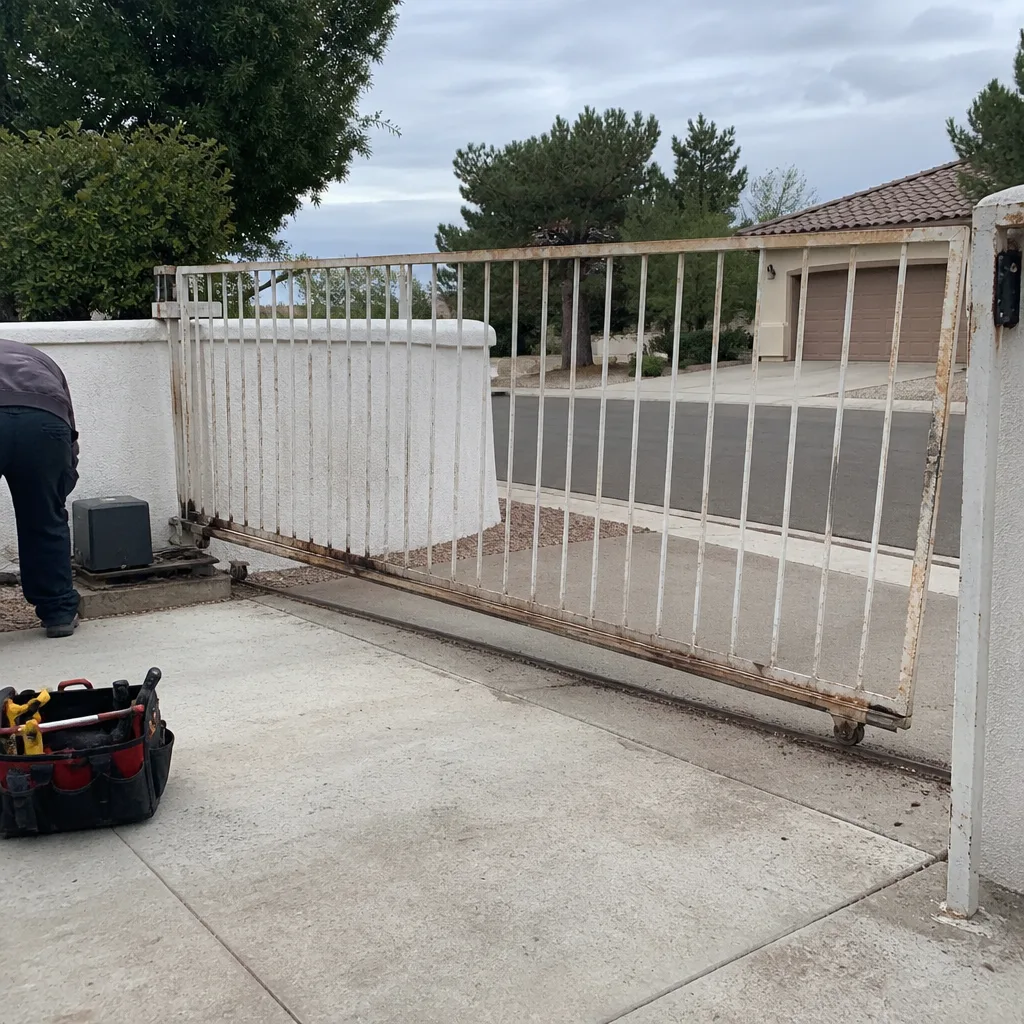 Before
 After
 Before
 After
 Before
 After
When to Call a Professional
Some gate work belongs in a monthly walk-around and some doesn’t. Diagnostics on the operator’s control board, rewiring that involves mains voltage, safety-edge testing that doesn’t produce reliable reversal, and any gate whose hinges have visible cracking or mounting damage all belong with a trained technician. Gate wiring carries mains voltage in places, and a shock across an energized terminal is serious. If a safety edge isn’t reversing reliably, or photo-eyes aren’t holding alignment after cleaning, that’s a solenoid, sensor, or wiring problem for someone with the meter and the training. The same goes for a gate that has to be manually assisted to complete a cycle, or a slide gate that has come off its track.
Gate Repair Enterprise offers free estimates in Enterprise – call (844) 423-3067. We answer 24/7. Fast dispatch from 7am to 7pm, Sunday through Friday, for repair visits. Whether you’re a homeowner with a stubborn operator or a property manager maintaining a commercial entrance, we diagnose at the source and quote the work before anything starts.
Frequently Asked Questions
An automatic gate in Enterprise should get monthly hinge and hardware checks, quarterly limit-switch and safety-edge tests, and one full annual visit that covers wiring, operator internals, and battery reserve. The wide seasonal temperature swing from 100°F+ summers to near-freezing winter nights compresses the calendar compared to milder climates, so quarterly checks aren’t optional here. Call (844) 423-3067 for a free estimate – we answer 24/7.
The monthly hinge and hardware inspection on an active gate is the most important single check, because hinges carry the full panel weight on every cycle and fail by fatigue rather than wear. Catching a loose bolt or a stress crack at the monthly look saves you a snapped hinge under load. A close second is the quarterly limit-switch test, which catches drift before it turns into over-travel or incomplete close. Schedule a maintenance visit with Gate Repair Enterprise for a full baseline.
No – chain, screw, and hydraulic drives each need a different lubricant, and using the wrong product causes faster wear than using none. In Enterprise’s dusty months, a wet grease on a chain turns into an abrasive paste, and the chain wears faster than it would dry. Use a chain-specific dry-film lubricant on chain drive, the manufacturer’s screw-drive grease on screw drive, and a mid-range lithium grease on hydraulic pivot points. Our gate repair technicians can identify your drive type and set the correct spec.
Test reserve capacity by counting how many full open-close cycles the gate completes on backup with main power disconnected, not just whether backup activates. A backup that engages and dies on the second cycle isn’t prepared for an outage. Record the cycle count each time and watch for a sudden drop between tests. In Enterprise’s heat, batteries lose reserve faster than in milder climates, so mid-summer testing catches fade earlier.
We work on your brand across the nine major gate and operator brands, including LiftMaster, FAAC, BFT, Linear, Viking, Ghost Controls, DoorKing, Elite, and Mighty Mule. Our technicians have up to 8 years of experience diagnosing each system’s quirks, from control boards and limit switches to wiring and access hardware. Call (844) 423-3067 for a free estimate – we answer 24/7.
Any safety-edge that doesn’t reverse reliably, any hinge with visible cracking or wallowed mounting, any slide gate off its track, and any control-board symptom beyond a limit-switch adjustment should become a repair call. Wiring that involves mains voltage is not a homeowner job. Our electric gate repair team diagnoses at the source and quotes the price before any work starts. Call (844) 423-3067 – free estimates, and we answer 24/7.
The Bottom Line
Gate maintenance isn’t an annual tune-up – it’s a staggered schedule built on how each component actually wears. Monthly checks on hinges and hardware, quarterly tests on limit switches, safety edges, and photo-eyes, and an annual inspection of wiring, operator internals, and battery reserve keep an automatic gate running far longer than a single yearly visit can. In Enterprise, the 100°F+ summers and near-freezing winter nights shorten the calendar, which makes the quarterly work more important here than in a milder climate. Lubricate the right parts with the right spec, log the baselines, and catch drift while it’s still drift. When something needs a technician, Gate Repair Enterprise offers free estimates, and we handle the repair or the full installation under one roof.
Written by the team at Gate Repair Enterprise.